Tuesday, June 19, 2012

Going Organic


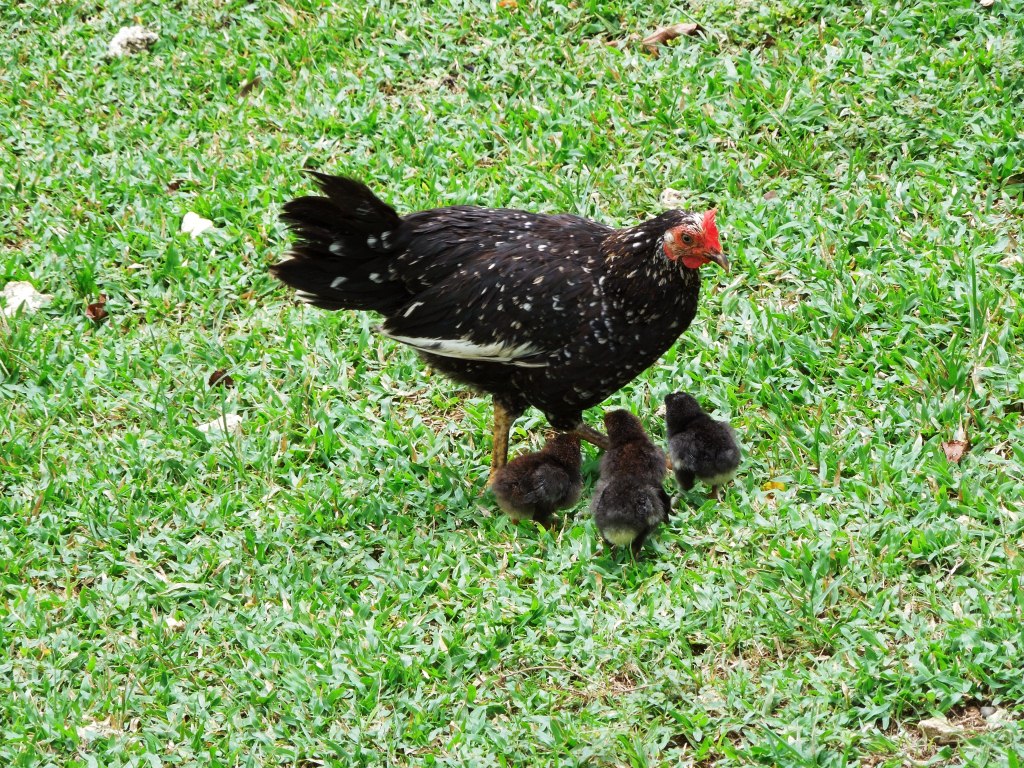
One of our common fowl hens, Theresa, and her peeps

Since arriving in Bluefields, I have “gone organic” in a major way. I am studying it, promoting it, writing business plans for it, and eating it when it is available. For the next two years I will be working hard to get more farmers to go organic too. Have I raised any eyebrows yet?

Don’t get me wrong, I am still an equal-opportunity lover of agriculture in all of its forms. I think the mudslinging and misinformation in the organic vs. conventional contest is embarrassing for agriculture and erodes the ability to progress. Similar to other areas of the human existence, I believe research and development in new technologies, be they biotechnological or natural/organic, has the potential to greatly improve the human condition. But like I said, I am an agricultural pragmatist, if you will. I am for matching the food production system to local conditions in a way that achieves environmental, social, and economic sustainability and contributes to the most food security.

That being said, I feel very fortunate to have been placed with the Westmoreland Organic Farmers Specially Authorized Society (WOFSAS); the long name is a product of bureaucracy. Bluefields is a coastal community located along a bay that is rich in history and currently serves as a fish sanctuary. The terrain rises to 2000ft of elevation within a few miles of the shoreline. Most of the farmers work small plots of rocky government-owned ground with little hope of ever holding a deed for the land. Many farmers in Jamaica suffer from illiteracy, which is especially problematic and results in over-application or misuse when they apply chemical fertilizer, pesticides, and herbicides. This is problematic enough in gently sloping areas; can you imagine the impacts of over-application of agro-chemicals in a steep slope coastal region that is supposed to be serving as protected habitat for marine life? That’s just a small piece of the calculus that makes me confident that organic agriculture is optimal in the paradigm of environmental, social, and economic sustainability for Bluefields, Jamaica.

So there you have it, for the next two years I am all about organic agriculture (but don’t expect me to “take sides”). I really want WOFSAS and local farmers to achieve success in growing and marketing their organic produce to eager customers in the tourism and food industry in our little part of the island. I hope their children will grow to love growing things as much as their families and as much as I do. At the end of the day, it’s all about treating the land, the animals, and people with respect and keeping future generations in mind. And you don’t have to be certified anything to do that.

Friday, June 1, 2012

Bluefields Beginnings

Goat got stuck trying to get a mango seed out of the box
Well, we have officially been Peace Corps Volunteers at our site in Bluefields for two weeks. Our focus thus far has really just been on making our cabin into a home, getting to know people, and learning about the organizations we work with. This “take it slow” approach is encouraged by Peace Corps to achieve two things, 1) to integrate into our community in such a way that increases personal safety, and 2) to fully understand the local knowledge, history, and assets that will inform and shape projects going forward. In fact, Peace Corps doesn’t even provide Program Design & Management training until the Early Service Conference (four months into service) because of the pitfalls of trying to get a big project going before really understanding the environment.

Our Community
As someone who served two tours in Iraq as a soldier and three months in South Sudan as a civilian, I feel truly blessed to have been placed here in Bluefields, Jamaica. Many of the farms I work on provide scenic views that blend verdant land and indigo Caribbean Sea. It is nowhere near as cool as some of the mountainous sites like where we trained in Woodford, but even though the sweat pours all day, I think we can make it down to the local beach just about every weekend. There are a few upscale villas and a Sandals resort nearby, so on first meeting a lot of locals assume we are short-term tourists. However, after speaking a little Patois and explaining where we live and what we do, they warm right up.

Bus on right is a typical "15 Passenger" taxi

We are adjusting to things like waiting for small taxi buses that hold 15 people, but cramming in with 20 or more. Our cabin is not plumbed into any public water service, so we haul water to the house in jugs and buckets. We have a 300 gallon tank next to the house designed to catch rainwater off of the roof to shower and flush the toilet, but since we haven’t gotten any rain I have had to haul water up on the roof to pour into the tank and may have to do it again soon. I am once again taking “combat showers” like in Iraq, which means turning on the water to get wet, then turning it off to scrub and turning it on again to quickly rinse off. We also only flush the toilet after going number two. One quickly becomes conscious of water consumption when you carry it all by hand.

Fixing up future Heritage Center
Some highlights of my activities so far include helping fix up an old police building that will become a heritage center for Bluefields, digging holes and putting in fence posts with a goat farmer, planting corn with my supervisor, and planning sessions with key leaders of the Westmoreland Organic Farmers Specially Authorized Society (WOFSAS). A lot of our work over the course of the year will include getting the group officially registered with the government, increasing the output of value-added organic products, and planning the second annual Bluefields Organic Expo & Sorrel Festival on December 19 & 20, 2012. 
Products made by WOFSAS


Unfortunately, I have a touch of the flu so I am going to cut things off here. We have the internet back up and running in our cabin, so feel free to leave a comment/question or shoot me an email.

Tuesday, May 22, 2012

Making it Official


Linnae and I at Swearing-In Ceremony

Well, it’s been a couple of weeks since I last updated this blog. When last you heard from me, technical training was coming to a close and we were getting ready to leave Woodford for Kingston (or “town” as Jamaicans refer to it). Reconvening in “town” was a fun experience because we got to meet up with the Trainees from the Education and Youth as Promise sectors and learn what their previous five weeks had been like. It was a pretty exciting two days. The first day we had a bit of training and then our sites were revealed to us in the afternoon. Our Program Manager had been developing the sites over the last several months; making sure that partner organizations were appropriate for each volunteer and that housing was safe and adequate. He used Google Earth in such a way that for each trainee, the view would start as a zoomed out satellite image of Jamaica and then it would zoom in to the community where each person would serve. It was then we learned our home and work site for the next two years would be Bluefields in Westmoreland parish. 

Sunset over Bluefields Bay
 In our opinion, being placed in Bluefields was like hitting the Super Lotto Jackpot of Peace Corps locations. Bluefields is a sleepy bayside community of fishermen and farmers where Linnae and I are living in rustic conditions, but have the blessings of wonderful people to work with and turquoise waters to relax in. More about that later. The other information we learned at the site revealing ceremony is who we will be working with. My partner organization is the Westmoreland Organic Farmers Specially Authorized Society (WOFSAS). The organization used to be simply named Bluefields Organic Farmers Group, but because of the type of NGO status they wanted to qualify for and some unfortunate naming policies, WOFSAS is their new unwieldy name. Linnae has been assigned to the Bluefields Bay Fishermen’s Friendly Society (BBFFS). I will commit a blog post to our duties later.

Our little cabin
OK, let me backtrack a little. So, we learned about our site locations that first day back in Kingston. The next day, we all got to meet our counterparts. For Linnae and I that meant meeting the presidents of WOFSAS (Brian) and BBFFS (Wolde). The morning of that second day was spent with introductions and small talk with our counterparts followed by lunch and then loading all of our luggage into a van and heading west across the island for site orientation week. When we finally arrived at our yard (in Jamaica, yard is a term that refers to the area that a cluster of houses are located, often an extended family situation), I breathed a sigh of relief for a few reasons: 1) I knew we were done hauling our luggage around for a long time, 2) I could tell immediately that there was a lot of character in our yard and community, 3) our living conditions are as rustic as the average Peace Corps Volunteer, negating the “Posh Corps” stereotype Jamaica gets. Linnae and I live in a 400 sq ft wooden cabin that relies on catching rain water to fill a tank that provides our bathing, dishwashing, and toilet water. I will admit we are a little spoiled by the fact that the previous Volunteer was able to acquire free internet from some high-end villas down on the bay. We happen to be in line with the signal that is broadcast to their office and guesthouses. I will soon commit a blog post to describing our living situation and talk about our new host-mother “Bumpy” and the extended family in the yard.  

Side view of cabin
Fixing lunch with Kevin
Fishing beach where Linnae and I work
Site orientation week mainly consisted of getting to know community members, unpacking, and being driven around to schools and other areas of interest. We were in Bluefields from Tuesday to Saturday morning, when we all headed back to Kingston via public transportation. After about five hours of travel we finally arrived at the hotel, but we were heartened by the fact that we only had six days before swearing in, becoming official, and starting the next phase of our adventure. There isn’t much to report on about that week, except of course for the big swearing in ceremony at the U.S. Ambassador’s residence.

Lion Fish, a delicious invasive species
 This year marks the 50th anniversary of Peace Corps in Jamaica and also the 50th anniversary of Jamaican independence from Britain. Therefore, our ceremony was a big “to do”. All in all there were over 250 guests including a former Prime Minister, the current Governor General, high-level Jamaican politicians, the U.S. Ambassador, the media (we made the evening news), and more. The ceremony consisted of remarks from the Jamaica Governor General and Peace Corps officials, a musical performance, the administration of the oath that transferred our status from Trainee to Volunteer, brief remarks from myself and two other Volunteers nominated to speak on behalf of their sector, and a ceremonial cutting of the 50th Anniversary cake. It was a hot morning in Town, so I was glad to climb back into Linnae’s supervisor’s van and cruise back to our seaside home away from home. 

Fisherman with a stringer of snapper
I realize I have condensed two weeks of hustle and bustle into just over 900 words. Now that we are settled in, I will try to blog a little more frequently or at least with more specificity so as to better share our experiences in the “real” Jamaica. Until next time, Walk Good

Saturday, May 5, 2012

Last Week, Farmer Field School, and Finding a New Home

Getting the bed ready
We have just finished our final week of Agriculture/Environment based training in Woodford. Like the week before, we were engaged in practice-based experiential learning. The highlight for me was the Farmer Field School that we facilitated. We also did some more work in hillside farming and companion cropping. The local extension agents from the Rural Agriculture Development Authority (RADA) spent a lot of time with us sharing their technical knowledge as well as their experiences working in the Jamaican context.

On Tuesday, we finished breaking ground in our hillside plot and inter-cropped tomatoes with scallions (the odor of the scallions repels bugs from tomatoes). This involved breaking up the soil with a large hoe and turning the soil with a large fork. Once the ground was broken up and leveled back out, we used the end of a machete to carve out little holes for the seedlings. After getting the seedlings firmly in the ground and adding a little water, we were done for the day. It all got done pretty quickly with about twelve people working at any given time.

Wednesday the RADA marketing officer for St. Andrew parish came to speak with us. I found it interesting that a lot of his work revolves around linking farmers with buyers, whereas most farmers in the U.S. have the ability to carry out this function for themselves. I look forward to learning more about the knowledge and information systems available to farmers and how varied levels of literacy affect access to these systems.

Thursday morning we held the Farmer Field School (FFS). Usually, a FFS consists of many sessions over the course of a growing season, so one could argue it wasn’t technically a FFS since it was a one-off event. Regardless, it was a good opportunity for us to become familiar with the model and to experience facilitating farmer-centered training. The official start time for the event was announced as 8:30am, but by 9:00 we had about three people. A few minutes later we were up to about seven, and then by 10:00 we had 16 participants (a lesson in “island time”). Since many of the farmers had met with us the week prior for a general discussion, we started by revisiting a few of their main concerns related to market prices and availability of market information. Since these are things that an individual farmer has little control of, we shifted the focus to another way of making more money: reducing input costs. The problem is few farmers keep records of their expenditures, so they have no idea what their cost of production is for any given crop. The intent was for the farmers to become aware of their costs and identify ways of increasing the profit margin by reducing inputs. Two or three seemed interested enough adopt the practice. As part of this session, we introduced the farmers to the Jamaica Agriculture Market Information System (JAMIS). JAMIS is a new online tool that makes weekly market prices available at various points in the chain: farmgate, municipal, wholesale, and retail. It is a pretty extensive database that relies on input from the RADA marketing officers in each parish. The idea is to make pricing more transparent and to help farmers identify better opportunities. The participant that showed the most interest in this was "Ziggy", a twenty-something farmer with a high level of literacy and business sense. It would be interesting to see how he utilizes the JAMIS system to build his enterprise.

Making pesticide from neem
 Other sessions in the FFS included making natural pesticides from neem tree leaves as well as household items like dish soap, garlic, pepper, and vinegar.A few farmers seemed interested in trying it because it is cheaper and safer to apply. Keep in mind; many of these farmers have less than two acres. Some of them were already using this technology and it resulted in good discussion within the group. For the last session, we had the farmers teach us how and why they plant certain crops according to the moon phases. The farmers really enjoyed taking on the role of teacher and we certainly learned a lot; the first quarter is a busy time for farmers! All in all the FFS was a great experience and I hope to be involved in regular training like this when I get to my permanent site.

Thursday evening we had a big potluck where all the host families and trainees got together. Many of the trainees cooked dishes too, so there was a variety of food to choose from. Most people went home with belly aches from overeating. We really enjoyed ourselves and we could tell that the families we have been with genuinely cared for us and appreciated having us stay with them for these five weeks.

Friday was spent reviewing all we have covered in training and wrapping up some administrative items in the morning. In the afternoon we worked on a special presentation we will be making in Kingston on Monday when we reconvene with the rest of Group 83 (Youth as Promise & Education sectors). I won’t give away any of the details now, but it should be pretty awesome.

Well camoflauged insect I found on my shirt
Monday afternoon, Linnae and I will find out exactly where we will be living and the Jamaican counterparts we will work with over the next two years. On Tuesday we will meet these counterparts and they will take us to our little spot on the island. We will stay there for four days and then return to Kingston for some final training as a group which will culminate with a swearing in ceremony on the 18th and the beginning of 24 months of agricultural teaching, research, and outreach.

Sunday, April 29, 2012

Getting Practical

I'm like a weed-whacking Samurai

Prepping seed trays with Tom and RADA agent


Week four of our Hub-based Training has gotten downright practical and we loved it. The week started at a nearby demonstration plot managed by the Rural Agriculture Development Agency (RADA) of the Ministry of Agriculture and Forestry. RADA is essentially the agricultural extension service of Jamaica. This particular farm consists of about two acres and is used to demonstrate hillside farming techniques for more sustainable farming. First, our group helped plant some seed trays of tomato and cabbage. Afterward we cleared weeds out of about three beds and turned the soil. The last phase was measuring out the beds and planting some Scotch Bonnet pepper sprouts at the appropriate intervals, giving each plant just a sprinkle of 20-20-20. I hope one of these demonstration plots will be nearby the site Linnae and I will end up living as they can serve as a great venue for introducing technology. 

Chris teaching us to identify contours at ZionItes
On Tuesday we switched gears a bit and took a bus up to St. Ann parish to visit ZionItes organic farm. Managed by a Rastafarian Jamaican (Chris) and his American wife (Lisa), the farm sits on 15 acres of a predominantly hillside landscape. At the time we were there I would estimate about five acres to be in production. Chris taught us about the principles of organic farming, how to use an A-frame to determine contour, and how to construct a compost heap out of locally available material. Lisa is the marketing force behind the farm. She talked to us about how she has established linkages to the high-end villas, restaurant, and hotel chefs, which has allowed them to achieve pretty high rates of return. She also does her own agro-processing in terms of making bread, salad dressing, and a killer hot sauce. While we were on the farm we picked our own salad greens to eat with our lunch of soup, fresh banana bread, homemade wheat bread, and stir fried vegetables. The contrast of Chris and Lisa made them a lot of fun to learn from. Chris is a mild-mannered, barefoot farmer living in the bush with his former NYC school principal wife with noticeable remnants of Brooklyn style. Regardless, they churn out some pretty tasty produce and seem to be having fun doing it.   
Setting up the lower barrier
There are two Aggies in this photo!
Wednesday we were visited by extension agents from RADA for some hands-on training. There is a small demo plot right next to our training center. So, with machetes in hand we chopped down and chopped up bamboo, cleared most of the grass off a hillside, and put in place a solid barrier on the bottom and planted pineapple to serve as a barrier on the top of the slope. This coming week we will further develop the plot and plant some more crops. After three days of hands-on experience, I realize how convenient it is to live and farm on flat land back home. If I lived down here, I’d probably try to make it in livestock.                                                                   

Thursday we visited one of the three certified organic farms in Jamaica, which just happens to be here in Woodford. The tour was led by the woman who runs the farm as well as the lady who is president of the Jamaica Organic Agriculture Movement (JOAM). JOAM is an NGO which serves as the certifying body on the island, whereas the USDA certifies farms in the U.S. This was another worthwhile tour, but it has become apparent that there are some obstacles to adoption of organic farming in Jamaica.  Converting to organic is a knowledge intensive process that requires more literacy and numeracy than many Jamaican farmers have. It also takes three years to convert and during which yields initially decline, so farmers would need to have sizeable savings as a buffer. There is also a ceiling for demand because the country has a fairly small middle class. There are a lot of ecologically fragile areas of the island where organic is probably the only responsible farming method, it is just going to be a struggle to get it to take root (pun intended).
Hillside beds at organic farm in Woodford


Friday we stayed inside, mainly because the rain fell most of the day. In the morning some other volunteers and I gave brief lessons on skills from our background that might be useful in the Ag/Env sector. I did mine on Participatory Learning & Action (Google it) because it complements the strategies that Peace Corps recommends for working with  a community to analyze issues and act on needs. PLA is also going to be a component of my Master’s thesis. That afternoon, a group of local farmers came for an open forum on agricultural issues. They graciously fielded rapid-fire questions from us on a range of topics. I was interested to find out that marketing was chief among their concern. I guess I expected more conversation about production issues. Some of the market problems were regular gluts, low farmgate prices, and international competition. I really look forward to having similar discussions with farmers when I get to site, I just hope they will be open and motivated to work on things at a grassroots level.
Doctor Bird (male)

On Saturday, Linnae and I went to church and attended a nine-night. We arrived at the Seventh Day Adventist church at about 9:30 am. For about the first hour there was singing and bible study. This was followed by two baptisms and communion ceremonies. The SDA communion was an interesting experience as they practice the washing of feet as Jesus washed the feet of his disciples at the Lord’s Supper. The congregation was split by males and females for the humbling practice of washing one another’s feet. One definitely feels part of the community after that exercise. The remainder of communion was pretty normal and consisted of the bread and wine. At about 3:00pm the church took a recess for lunch; Linnae and I were able to come home at that point. She and I took a nap and were pretty lazy in preparation for the nine-night (wake). The nine-night is more or less an all-night party that is held about nine nights after a person dies and a day or two before the funeral. We got there at about 10:30 and left a little after 1:00, but the party was going strong.

Monday morning marks the beginning of the end of our training. We leave Woodford on Sunday for a brief stay in Kingston where we will find out the location of our service and our counterparts for the next 24 months. We will be getting down to the business of promoting improved agricultural practices and community development in no time.

Peace Corps Masters International
I’ve started to get a little more time to get back to reviewing literature. I recently finished a book on Participatory Rural Appraisal (PRA) and am now working on a book about mixed-method research in development. My parents are soon sending my writer’s guide, statistics book, and some other texts (how’s that for a care package?). People keep asking me what my thesis is going to be focused on, but my answer remains that it really depends on my community and the work that I will be doing there. I do feel confident that it will be nested in PRA, diffusion of innovations theory, and have a mixed-method design (qualitative and quantitative). It is a good thing this will be social science research because it gives me the flexibility to design and collect data based on local conditions. It must be incredibly difficult for a natural sciences student to do PCMI.
Saturday, April 21, 2012

World’s Fastest Man


Bolt on left (100m world record holder) Powell on right (2nd fastest)

As I alluded to in last week’s post, we were hoping to catch a glimpse of the world’s fastest man Saturday at the track meet. Sure enough we got to see Usain Bolt and the world’s second fastest man Asafa Powell. The track meet was held at the national stadium in Kingston under pretty wet conditions. Rain fell in the area all day and only lightened a little bit during the races. The event included teams competing at the primary, high school, college, and club level (Powell and Bolt ran in separate clubs). It was fun to watch the runners and to experience the passion Jamaicans have for their athletes. Jamaica definitely churns out world class competitors for being a relatively small island nation.
Bolt (in lead) and Powell cruise to the finish in 400m relay
Usain Bolt: World's Fastest Man

Sunday morning was time for laundry, again. Linnae and I spent almost three hours scrubbing and scrubbing. I hate to do it, but I am going to have to start wearing more things multiple times, at least until we move to our permanent site and I have time to wash several times during the week. The sun was shining and the wind was blowing in the morning so we were confident our things would dry quickly. But, as it goes in the Blue Mountains, the clouds suddenly began to roll in over the peaks behind us and by early afternoon we had to move all the clothes to a line on the upstairs porch. The rest of the day was damp and rainy. We were sweating it a little bit since we had to leave early the next morning to travel to another parish to shadow a full-blown Peace Corps Volunteer (PCV). Fortunately, enough clothes were dry in the morning and what wasn’t I quickly dried with Linnae’s hair dryer.

Monday morning we walked down the hill to the square in Woodford to start our all public transportation journey to a small community near St. Ann’s Bay in St. Ann parish. It was about 6:00 AM when we arrived at the square on foot; there were about half of our group already waiting. A few moments later one of the buses (passenger van) rolled up and we piled in. By the time the bus was done picking up passengers in Woodford, I think we hauled 18 people to north Kingston in a bus smaller than a Ford cargo van. Once we got to north Kingston (Papine to be specific), we found the large passenger bus that would take us on the next leg of the journey to southeast Kingston to a spot called the “country bus park”. Southeast Kingston is off limits to PCVs for any purposes except traveling through, but on a bright Monday morning there isn’t too much to worry about. We took the bus to the stop closest to the bus park and walked the remaining four or five blocks through the market area. At the bus park is where most of us parted ways. Each of us had to find another smallish van/bus to take us on the next leg into the countryside. Another trainee, Linnae, and I found the one for Ocho Rios (Ochi) without any trouble. The only problem is that you really never know when you will depart, because you have to wait until the van is adequately full (the more people crammed in the more the trip is worth to the driver). We sat in the van for about hour and a couple more trainees from another Peace Corps sector joined us too. Along the way we shared stories and training experiences. Once in Ochi, Linnae, the other trainee and I hailed a taxi to take us to the library in St. Ann’s Bay where we would meet our PCV for the shadowing. We linked up with her around 10:45 AM, chatted in the library, had lunch, and hailed one more taxi to go up into the countryside where she lives and works. Five vehicles and $710J ($8.20 USD) later we had made it to our destination near the island’s north coast.

Shadowing the PCV was a great experience because we got so see how she lives and interacts with folks like her host family, supervisor, project partners, and locals. Some PCVs like her need to be very self-directed and motivated. This is because some PCVs are placed with an agency or organization that can keep them very busy, whereas others are underemployed and have to take initiative to start education and/or community oriented projects on their own. Things didn’t work out at her previous site, so she had been moved to her new community three months ago. Therefore, she was still focusing mainly on integration and building relationships and trust with the people in the area. This might seem like a waste of time, but it is actually the single most effective way to ensure personal safety in Jamaica, not to mention it is necessary for identifying needs and assets for addressing issues.

On Tuesday we went with the PCVs supervisor to do a gardening lesson at a basic school (preschool) in the much more affluent Discovery Bay. The school was run by Canadian expats and may have been better equipped than the one I once attended; definitely an anomaly on the island. The kids were great though and it was really good practice for working with that age group.

Overall, we had a good time chatting and learning from the PCV we shadowed. She gave us tips for shopping, traveling, and working as a volunteer. We cooked a great meal of snapper, yam, and a curry-pumpkin rundown and ate off of plates we borrowed from the neighbor. The community is not plumbed, so we hauled jugs of collected rainwater into the house to flush the toilet. Everyone in the community collects rain and has to be conscious of how much they use to avoid running out.

Human-Knot Icebreaker
Friday we conducted our second Eco-Camp, this time at a local elementary school with sixth graders. The focus was on celebrating Earth Day and we did activities like weeding the garden, planting trees, a nature scavenger hunt, painting rocks for the garden, and more. I led one of the scavenger hunt teams, dug holes for trees and helped some students plant a Lignum Vitae tree. Linnae helped with registration, helped paint rocks, and helped out where needed. Once again, good training and experience for us before we go out and work with Jamaican youth on our own. 
Tree planting on hillside
Just two more weeks of training remain.

 Somewhere around May 7th we will learn our site locations and Jamaican counterparts. Once that happens we will move into our new home and stay there for a few days to get to know our host-family and the organization we will be primarily working with. Then we will be back in Kingston for a little more training and the long awaited swearing in at the U.S. Embassy. After that, it’s back to our community for 24 months!

Saturday, April 14, 2012

Wedding Bells and Pickney Yells

Jamaica Sunset at 3200ft 
On Monday, about nine of us Peace Corps Trainees (PCT) had the opportunity to go to a big wedding in Kingston for a couple from here in Woodford. We all agree that it was an interesting experience. The ceremony was slated to begin at noon, but the bridal party didn’t start making their way down the aisle until about 1:45; I guess that’s “island time” at play. We found that weddings are definitely an occasion for wearing gowns and big hats or fancy suits. Most of we PCTs were comparatively underdressed, including myself. The Seventh Day Adventist (SDA) ceremony had many of the same components of an American wedding with prayer, songs, praise, and exchanging of vows. However, there was one surprising and striking difference. Our experience living with a family and in a community of SDA Christians is that they are very conservative. That being said, I have never heard a marriage ceremony so full of sexual innuendo. I guess it is common practice to make light of what happens between a bride and groom on the wedding night.

At the reception, we learned that speeches are a staple of such events. There were at least eight toasts and a couple of impromptu speeches. Additionally, there were probably five or six musical performances by very talented singers; most were family/friends. Food was served buffet style and consisted of traditional Jamaican dishes. The final toast was made around 9:15, so we rode back home to Woodford after about eight and a half hours of wedding festivities. The photographer and videographer definitely earned their pay Monday and there were some tired PCTs at training Tuesday morning.

There isn’t much to highlight about training from Tuesday through Thursday other than learning more about environmental issues on the island and preparing a half-day Eco-Camp for some of the pickneys (children) of Woodford.

Linnae at the Eco-Camp Registration Table
The Eco-Camp is an activity that is part community outreach and part training for us volunteers. It was a great way to introduce us to youth focused events while building some environmental awareness. Registration opened at 8:00 AM and about 70% of the participants (5th & 6th graders) were there by 9:30 with the rest trickling in throughout the morning. Linnae served as the event coordinator and me as one of four House (group) Leaders. The children played games and did activities based on things like the water cycle, competition for resources, misuse of agro-chemicals, and the plant life cycle. All in all it was a lot of fun and we learned that Jamaican pickneys are not so different from American children. They love to play games and compete, form little cliques, occasionally fight, but are generally respectful of authority. We did notice that they are a likkle (little) afraid of being wrong when asked to answer a question in front of the group. Regardless, it was great experience and practice for our next Eco-Camp which we will put on for a local 4-H group next week.
Students learning about the water cycle and run-off

Later in the afternoon on Friday, Linnae and I learned that we will soon be traveling to Saint Ann parish to shadow a current Peace Corps Volunteer (PCV) who has been working there for the past several months. We will be there for a couple of nights and get to see what the PCV’s day to day activities include, how he/she lives, and also how he/she works with project partners. This particular PCV works with an organization called the Jamaica Organic Agriculture Movement (JOAM), an organization that trains and certifies farmers in organic farming. I still have much to learn about both organic and tropical agriculture, so this should be a pretty rewarding experience. It will also be a test of our ability to navigate public transportation, which is prevalent and cheap here in Jamaica. Linnae and I will be traveling with another PCT, Alyssa, who just happens to be a Texas A&M graduate. Between our Aggie and Buckeye skills I think the three of us will be just fine.

Today our Green Initiative group is going down to Kingston for a little R&R. Our agenda includes getting the best ice cream in town, watching a track meet (maybe catching a glimpse of Usain Bolt), and getting some Mexican food. We figure we might as well live a little since our permanent placements will mostly be deep rural. Speaking of which, Linnae and I don’t know yet what community we will live in for the next two years. Fortunately, our Program Manager says he has known for a while where he wants to send us, so we suspect that the site will be well prepared and appropriate for our skills and interests.