Thursday, February 13, 2014

10 Months in 5 Paragraphs

Slowly But Surely
Day One at Demo Farm
Hello? Is anybody still there? It has been nearly a year since I have blogged, so I surely understand if you have stopped checking in for updates. I don’t know exactly why I stopped chronicling this Peace Corps experience. I guess with blogging you don’t really get much feedback about what you are sharing and I don’t care to feel like I am talking to myself (except for when I am intentionally talking to myself). However, I do recall being taught that reflecting on experiences is an important part of internalizing the lessons learned from them. So…I’m back.
Food Afield

Last I shared a blog, I was about to embark on helping the farmers’ group implement a climate change adaptation and alternative livelihoods grant project; one for which I helped them earn the funding. We wrapped up that project back in October and wow what a hectic seven months. You see, there was also a commercial-scale aquaponics project in the works for the group prior to my arrival and the donor finally got around to starting it at the exact time the funds were awarded for our grant. It is taxing enough to coax people with low incomes into volunteering time to a project when they could/should be using that time toward their regular livelihood activities. It is doubly difficult to do this when there are two projects that need lots of attention. But, we did it. After months of digging holes, slashing weeds, mixing and carrying concrete, procuring equipment, setting up an office, and hosting Farmer Field Schools, we have much to show for our sore muscles and strained household finances.
Clearing Brush from the Farm
Because of the efforts over the last ten months, the group now has a one-acre organic demonstration farm equipped with water catchment and drip irrigation. With the improved equipment we purchased they are also able to more efficiently manufacture value-added products. Several members of the community attended our Farmer Field Schools and learned about the impact climate change is having on local rainfall and some practical on-farm mitigation strategies. Here are some photos that may help you visualize this project.

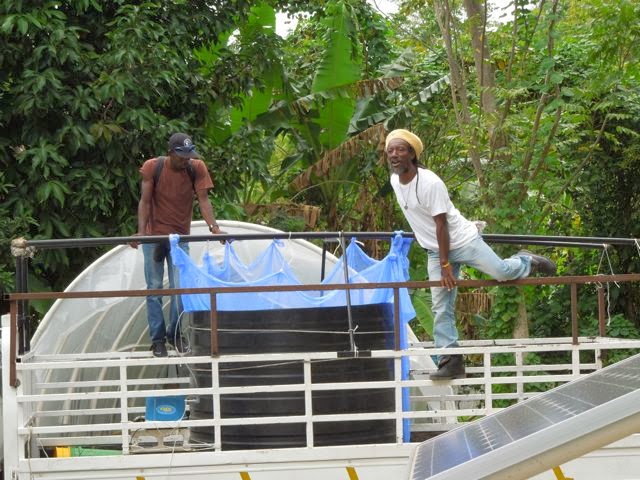
The farmers’ group was responsible for implementing the climate change adaptation and alternative livelihoods grant, but the aquaponics project is being managed by a sub-contractor of the donor. One of the conditions for receiving the system was that we provide an in-kind contribution of labor to construct the unit. I have never seen so many 40, 50, and 60+ year old men and women work like I saw these Jamaicans work on this project. We dug holes with pick axes and shovels and inside the holes we built forms and poured concrete for tilapia fish tanks. Since we could only afford occasional help from a backhoe operator, we also leveled land with farming hoes, shovels, and wheel barrows. When it was time to pour concrete, it was men and women sweating in the sun until clothes were soaked and biceps were burning. Finally, the laborious part is over and yesterday a few thousand tilapia fingerlings were delivered and soon hundreds of seedlings will be planted and then transplanted into the grow beds. The system takes up less than a quarter acre, but can produce as much lettuce as 2 acres under regular terrestrial cultivation. With ideal conditions, the group should be able to sell 2400 tilapia fish per year in addition to the vegetables.

The aquaponics system will become an important source of income generation for the group, but it will be some time before members receive benefits commensurate with the level of effort they put into this project. It has definitely caused me to adopt a more nuanced view on the mandatory in-kind contributions demanded of low-income persons in developing countries. I think donors need to be careful that they don't mistake local cash and in-kind contributions for real beneficiary buy-in or ownership. After all, these are people whose livelihoods are fragile enough that one unexpected event can send them reeling. What if this project fails because of an error the donor made or a design flaw in this rather experimental aquaponics system? Will these men and women be reimbursed for all the valuable time donated to a failure they are not responsible for? Remember, they could have been using that time to work their farm or do day labor. This is definitely something I will consider as I proceed with my career in international agricultural development. Just one of many lessons learned from my time here in Jamaica. 

Putting on the Roof
That's all for now. Sorry for the hiatus and that this blog is so long yet too short to adequately describe the last ten months. Tune in again soon as I describe my philosophy on hitting the milestone of 30 years on this funny planet.


Brian Taking in the View
Had to Finish Roof by Sundown


Brian (left) teaching at Farmer Field School
Going over the Basics of Composting
Another Farmer Field School
Practicing a Crop Rotation Plan
The Happy Participants


Well of course we carried concrete ingredients up the hill
One bag at a time...again and again and...
Carry 94lb bags of cement up that hill earns instant credibility


Lining out the concrete pad
Mixing it up into a slurry
I sometimes wonder if we do anything good for our backs
Brining up a 1000 gal tank
"I think I can, I think I can, I think I can..."


One of four
Setting up the drip irrigation


Connecting the tanks


Connecting the main lines
Mainlines and sub-mains running down the farm


Our First Crop of Sorrel
Lining out the aquaponics system
Lots of digging
Pick axes, flat shovels, and lots of rocks
An air conditioned ride home from the work site
I will forever be impressed by these women

Lots of tasty meals came from this kitchen


Brian and I digging tilapia tanks
Yes They Can


The Concrete Line
Forms for the tilapia tanks
Teamwork
Things are looking pretty serious now
Cooking and waiting for the baby fish
Brian using his field expedient grater to prep some pumpkin

I think Brian was on there before the truck came to a halt


Opton and the Tilapia

Grow babies, grow!
Soon to be a protein and vegetable producing machine!
It rained a bit, but couldn't dampen any spirits

Taking refuge in the new nursery house


Sunday, April 28, 2013

When Preparation Meets Opportunity


Me (left), Farmers (the gentlemen), and NEPA representatives presenting the check. We clean up good!

I have alluded a few times in previous posts about a project in the works or good news I hope to reveal in the near future. Well, that time has finally come. It is a long process that started three months after I arrived in Bluefields, Jamaica. Tuesday, April 23rd, 2013 marked the beginning of the Bluefields Climate Adaptation Technology for Organic Agro-business Development project. This is the first grant won by the Westmoreland Organic Farmers Society (WOFS) and I have taken great pleasure in facilitating the process from the conceptualization phase to now.

Back in August I led a needs assessment and priority ranking exercise with WOFS. It was an eye opening experience for me and the farmers. Through the process we all learned that the collective needs and priorities were not exactly what we assumed they may be. The greatest of these needs were water, seeds, fencing, what they call farm houses (sturdy sheds), and agro-processing capacity. This new knowledge allowed us to come to a consensus about what we would like to accomplish over the next two years.

As if providentially ordained, two months later the National Environment and Planning Agency (NEPA) of Jamaica approached the Bluefields community to participate in an alternative livelihoods grant program. During a workshop NEPA explained that coastal communities like Bluefields will be the first to suffer the effects of climate change and alternatives to marine livelihoods will be necessary to adapt to these changes. Among the list of alternatives proffered were organic farming and agro-processing…cha ching! The workshop also informed community groups and organizations of the application process and some of the characteristics of a good proposal. Here was an opportunity to capture what we wanted to work toward in much less time.

The NEPA workshop occurred while I was in the U.S. for my sister’s wedding, so I got all this information second-hand. Then, I got dengue fever from a mosquito and was pretty much useless for two weeks. However, because of that handy-dandy needs assessment we did so recently, it was easy for the group to coalesce around a concept for the proposal. It wasn’t long before I had a first draft and a budget prepared. After a few rounds of revisions, the key leadership of WOFS approved and then we presented the proposal to the entire organization. With their consent, we then sent the proposal in to NEPA and let the waiting game begin.

More members of the group on the day our project began
In late February, we finally got a letter from NEPA congratulating us on being selected as a successful applicant. Two months later (last Tuesday), we got the first check.

I am skipping over a lot of little administrative hurdles we had to cross in the meantime: budget reduction and revisions, amending indicators, negotiating a letter of agreement, and more. In the end we are getting about $12,000USD to install a demonstration farm with rainwater harvesting and drip irrigation, purchase quality seeds, build a fence and a shed, and purchase materials and equipment to boost the agro-processing enterprise of the group. We will also be conducting a series of Farmer Field Schools to reach out to other farmers and fisher folk in the community. Don’t worry; I will devote another blog post to getting more descriptive about the objectives and activities of the project.

Ultimately, this is what I took a 90% pay cut to join Peace Corps to do. I wanted to experience development work absent the six-figure experts. Where goals and objectives and activities are generated from the ground up rather than through the aims of a hulking bilateral or multilateral development organization. The amount of funds I have helped WOFS win could easily be lost as a rounding error in many development projects; I have worked on such projects. However, every dime in this one is going where the beneficiaries want it to go and you certainly can’t say that about a lot of projects around the world.

I am really blessed to have been sent to live and work in this little corner of Jamaica with the great people of WOFS. I can’t wait to share more about this and other projects we are undertaking.


Wednesday, March 13, 2013

Master's International: Part Three

This is a reblog of the third and final post on student experiences with Peace Corps Master's International (PCMI) in the Department of Agricultural Leadership, Education, and Communications at Texas A&M University.

The first two entries in the series described students experiences enrolling in the program and receiving their invitation to serve. For the third part in the series, I was asked to provide my "on the ground" Peace Corps and research experiences as a PCMI participant. I hope you will enjoy. Click the link below. ↓


Master’s International Program: On the Ground

Tuesday, March 5, 2013

Masters International Series: Part Two

Last week I reblogged a post from the Department of Agricultural Leadership, Education, and Communications at Texas A&M. In that post, a Peace Corps Masters International (PCMI) enrollee shared her experiences in applying to graduate school and Peace Corps with the PCMI option.

The latest post in the series is about another PCMI participant at Texas A&M who has just received his invitation to serve. Click the link below to read his account of discovering where he will serve.

My contribution to this series should be posted in about a week. Please feel free to explore some of the other posts on the ALEC Abroad blog site as well!


Master’s International Program: Invitation to Paraguay


Thursday, February 28, 2013

Masters International Series, Part One

As some of you may know by now, I am a participant in Peace Corps Masters International (PCMI). This means I am combining my graduate degree and Peace Corps service such that I completed coursework at Texas A&M University (TAMU) and am conducing thesis research while serving in Jamaica. The Department of Agricultural Leadership, Education, and Communications back at TAMU operates a blog and is running a three part series of posts from PCMI participants currently enrolled and at various phases.

Part One was published today and features a PCMI participant who is taking classes and awaiting her invitation to a country of service.


Master’s International Program: A View from the Inside


Over the next three weeks, ALEC students Tegan Walker, Orry Pratt and Kevin Fath will share their insights and experiences with Masters International, a program that allows masters students to combine their education with service in the Peace Corps.

Tuesday, February 19, 2013

The Toughest Job You'll Ever Love


Over two months since the last blog post…my apologies.

A happy farmer and her goods
First order of business, a “big up” to the Westmoreland Organic Farmers Society (WOFS) for putting on a successful 2nd annual Bluefields Organic Expo & Sorrel Festival on December 20.  The event is still small by most standards, but there were more participants and attendees than last year. Valuable lessons learned and good times had. The purpose of the event is to raise awareness of environmentally friendly farming practices and to celebrate sorrel, a staple of the holiday season. The most common sorrel-based product is juice, but we experimented with fritters, festival, gizzada, cakes, and other delights. A fellow PCV was also involved as a group from her community in nearby Beeston Spring participated.
BioChar demonstration


Drummers
Organic Expo & Sorrel Festival
Now, one of the reasons for my lack of blogging is a sort of superstitious hesitance to talk about projects in the making. I would hate to share about something in the works and then follow up with a blog about how or why something failed. However, yesterday was a great day and definitely something worth talking about.

Over two years ago the PCV who preceded me began supporting the farmers’ effort to register their group with Jamaica’s Department of Cooperatives and Friendly Societies. He passed the baton to me back in May and on December 7th we finally got the final documents signed, sealed, and delivered to our humble organization here in Bluefields. Of course, with this official status comes new responsibility, one of which was to organize and hold an Inaugural General Meeting (IGM). This meant preparing a financial report, establishing a Nominating Committee, creating an agenda, sending notices, and a few other minor details.


Drummers & Dancers
As luck would have it, the IGM was scheduled for February 18 (my birthday). A representative from the Department of Cooperatives and Friendly Societies attended and fortunately arrived a little early. There were a few minor details we needed to correct before the meeting started, but at the end of the day, we got a "passing grade". A report was shared highlighting the achievements of the group and elections were held. WOFS now has a nine member Committee of Management consisting of five females and four males. My supervisor, Brian, maintained presidency and our secretary and treasurer remained the same as well. We also established an Audit Committee, Investigation Committee, Marketing Committee, and Environmental Committee. At the end of the day, many members took up a new position. Admittedly, it will take a little work from me to help outline the roles and responsibilities and transfer a few skills to some. Yesterday’s event is something that has been years in the making and the feeling of excitement and togetherness was palpable yesterday. (See song sung to open the meeting below)


As I have gotten older and hopefully a little wiser, I’ve come to take great joy in seeing others achieve their goals and being able to say I had a little part in making it happen. As I was about to leave the luncheon after the meeting, I mentioned to Brian that I thought today was a great birthday present. I saw his eyes get big as he realized he had forgotten. Before I knew it I had a room full of people singing the Happy Birthday song with all the flair and gusto Jamaica is known for. I know my flushed cheeks showed through my beard, but fortunately I was able to win the battle against my tear ducts. I have come to love the men and women of the farmers group and have no reservations about shedding blood, sweat, or maybe tears as my service continues. I guess this is why they call it the “toughest job you will ever love.” It took eleven months, but I am starting to understand where that phrase comes from.
IGM Meeting

Committee of Management
 PS. I really hope to share an other blog post soon to announce another big achievement based on our efforts here. But again, maybe I am too superstitious to spill the beans now.
Canoe on the Bay


Linnae and I at Rick's Cafe in Negril


Friday, December 7, 2012

My Dengue Fever and Wildly Unanticipated Life

I typed up this blog post and titled it almost a month ago during the final throws of Dengue fever. I decided to sit on it for a bit, knowing I might not be in the best state of mind to write this kind of thing. Looking at it now, I think it is safe to share. Interestingly, one of the final symptoms of Dengue is a few days of depression, so that might be the cause behind the genesis of this topic and the somber sounding ending. I assure you I am in a better state of mind today. Anyway, here you go:


November 2 will go down as the day I came down with Dengue Fever, a mosquito-borne virus that manifested itself in the following symptoms in no particular order of appearance: high fever, body ache, chronic low fever, upset stomach, diarrhea, rash, headache, pain behind eyes, fatigue, cold sweat, painful sensitivity on palms and soles of feet, dehydration, weight loss, nausea, and probably more…memory loss perhaps (that last one is a joke). I was in bed for about six days and am only now spending the whole day “up”. This ordeal has given me a lot of time “in my head” and one of the latest thoughts that got me thinking was, “How did I get here?” If I were to ask my 18 year old self there is no way I could have concocted the string of events that have unfolded over the last ten years of this unanticipated life that led to lying in Jamaica with a nasty illness.
Ohio farm where I was raised

I was going to raise pigs. That was my plan at one point. I was a true, blue 4-H and FFA kid who lived for the county fair. For example, my job shadowing experience in high school was at a large wean-to-finish hog barn in Knox County, Ohio. OK, swine farming was probably never going to be my primary occupation, but I definitely had a love for raising show quality pigs; Durocs specifically. The career I settled on out of high school was to be an agricultural science teacher at the high school level and I started as a freshman at the Agricultural and Technical Institute (ATI) branch of The Ohio State University. ATI was perfect: it was located in my hometown and was basically like an extra year of high school with nothing but farmers as classmates. ATI was affectionately referred to as the Alcohol and Tobacco Institute by students, probably because of all the farmhouse parties and so many Skoal rings in the back pocket of Wrangler jeans. My plan was to save money by starting at this branch before transferring down to main campus. Yup, I was living in hillbilly heaven and I was on my way.

Baquba, Iraq (probably 2004)
Or, so I thought. As the saying goes, “if you want to hear God laugh, tell him your plans.” At the end of 2002 and early 2003, George W. Bush was making a pretty darn good case for regime change in Iraq and just days after “shock and awe” commenced, I was proudly enlisted in the Army Reserve. So, after my first year of classes and bad grades, I completed the Army’s initial entry training and within a year I was off to Iraq, 20 years old and green.

There is an aptly named book called Fiasco about the first few years of the war. I would sum up the experiences of my first deployment as a bunch of military men and women doing what they could to make the best of a bad situation made worse by an administration that had no clear strategic vision or plan. This made coming home to the college setting…interesting. I wouldn’t call it PTSD, but I was definitely 21 and bitter, though fortunately a little more serious about my grades.

I was blessed to be able to start back to school at main campus by living with my best friend’s brother who was also a good friend. He was a couple years older and grounded, so I think that helped. However, after about a year, it became clear that I wasn’t cut out for high school teaching, so I changed majors to Animal Science with the intent of going into Extension education. That might have worked out, but in 2007 I met my future wife and also found out I had to go back to Iraq.

By January 2008 I was back in the Sunni triangle. The sequel to the aforementioned Fiasco is called The Gamble, which is about the surge and change in tactics that paid off so well. Current scandal notwithstanding, I feel I owe a great debt of gratitude to Gen. David Petraeus and guys like Amb. Ryan Crocker and Sec. Robert Gates for the much more purposeful experience I had the second go-round.

Bayji, Iraq (2008)
Iraq 2008 was where my career interests really started to shift. In addition to trying to keep al Qaeda out of Bayji, I had the privilege of working with civilian representatives from USDA and USAID (one of which sung the praises of his Peace Corps experience and how it helped him get his career going). I had heard about development work from Linnae, but this was the first time I saw it in action and appreciated the impact agricultural and economic development can have on peace and pacifying combatants. This was also the first time I had heard about Team Borlaug from Texas A&M University; a group of professors and specialists touring the country to do agriculture assessments. Significant acts (SIGACTS) of violence in our area of operations fell 80% while I was in country that year and I knew it wasn’t just because we had bigger guns and mine-resistant armor protected vehicles. Late that November I was back on American soil a newly minted Staff Sergeant with a new perspective.

I’ll never forget the day on campus when I stepped into the coffee shop, embittered by the stress of another deployment, while some girl who had gone well beyond adding a “freshmen fifteen” pounds was bopping away in her stretchpants to some music on her MP3 player. Just knowing what a different world existed between those earphones was unforgettable. But I digress. Linnae was working in Washington, DC and I was struggling through chemistry, biology, and physics and applying to a competitive summer internship program in DC. Fortunately, I made it into the program on my military laurels because my GPA was only then breaking above the 2.5 mark. After six months of us commuting on weekends, I was finally in DC with Linnae for an internship at the Foreign Agricultural Service at the USDA. This is where I learned much more about the possibilities for work in international agricultural development. I also learned more about that faraway school I mentioned earlier, the one that had been doing the work in Iraq while I was there.

Wedding Day: Hippie marries Soldier ;)
That fall of 2009, Linnae and I got married and she started grad school in Development Economics at Ohio State while I completed my senior year. I spent my last two years of school firmly planted on the Dean’s List, which paid off with admission to a Master’s program at Texas A&M (TAMU) the autumn after graduation. I took a few online Master’s classes that fall and we both submitted applications to the Peace Corps. On December 30th we were two Buckeyes and a dog U-Hauling it to College Station, Texas for my year of coursework as an Aggie. There are probably few campuses in America where a veteran feels as at ease as at TAMU. I really enjoyed my time there and volunteered often with the Norman Borlaug Institute for International Agriculture, even getting the opportunity to train some National Guard agriculture specialists before they deployed to Afghanistan. I helped train those Soldiers just a few months after my Army enlistment contract expired, so it was extra meaningful at the time.

Bor, South Sudan
Conversation with smallholders in South Sudan
Linnae and I were starting to get nervous as 2011 wore on and we weren’t getting an official Peace Corps invitation to serve. I was going to run out of courses and had no plans for doing my thesis research other than in Peace Corps. That is when I got a call from the director of the Borlaug Institute; the organization responsible for the Team Borlaug I had learned of three years prior in Iraq. The Borlaug Institute had just won an unsolicited bid for a USAID project in South Sudan and wanted me for a short-term gig as the project got started. What’s that you say? Post-conflict agricultural development and a bridge of employment before Peace Corps? Done! It was about a week later Linnae and I were pleasantly surprised with an invitation to serve in Jamaica. So, with a future more or less certain, for three months I worked the project in South Sudan and learned a lot about how projects in such environments evolve into order. I came home from Africa in mid-February, helped pack up the truck to move our things back to Ohio and we were in Jamaica by mid-March.
Wash time in Westmoreland, Jamaica

So, in a nutshell, I guess that is how I got “here” to the middle of the Caribbean with a tropical illness and a world completely different from anything I have ever known. The hardest things is not knowing if my life will be able to follow a path back to the things I loved before this string of events began to unfold. Will I again get to live a significant portion of my life in the quietude of rural life? Will I be able to give my children the opportunity to participate in 4-H and FFA or exhibit something at the county fair? How will I connect to our children if I must raise them in a place drastically different from what I was raised in? Some people look at rural Americans as backward or xenophobic, but I know differently. There is something special about life outside the rat race. Whatever that something special is may not be objectively better than where you come from, but from my subjective perspective it is and getting more of it back in my life has been on my mind.   


Just listening to a man about his goats
I don’t know if this is an early mid-life crisis or just what happens when a boy has been too long away from the farm. Maybe they just need to add homesick to the list of Dengue Fever symptoms.